
Ethereum Pulls Its Own Issuance Burn, Fake GIWA Bridge Drains 766 ETH
Ethereum pulled its staking reward burn from Hegotá, a fake GIWA bridge drained 766 ETH, and whale flow sits dead flat. The week, with the numbers.
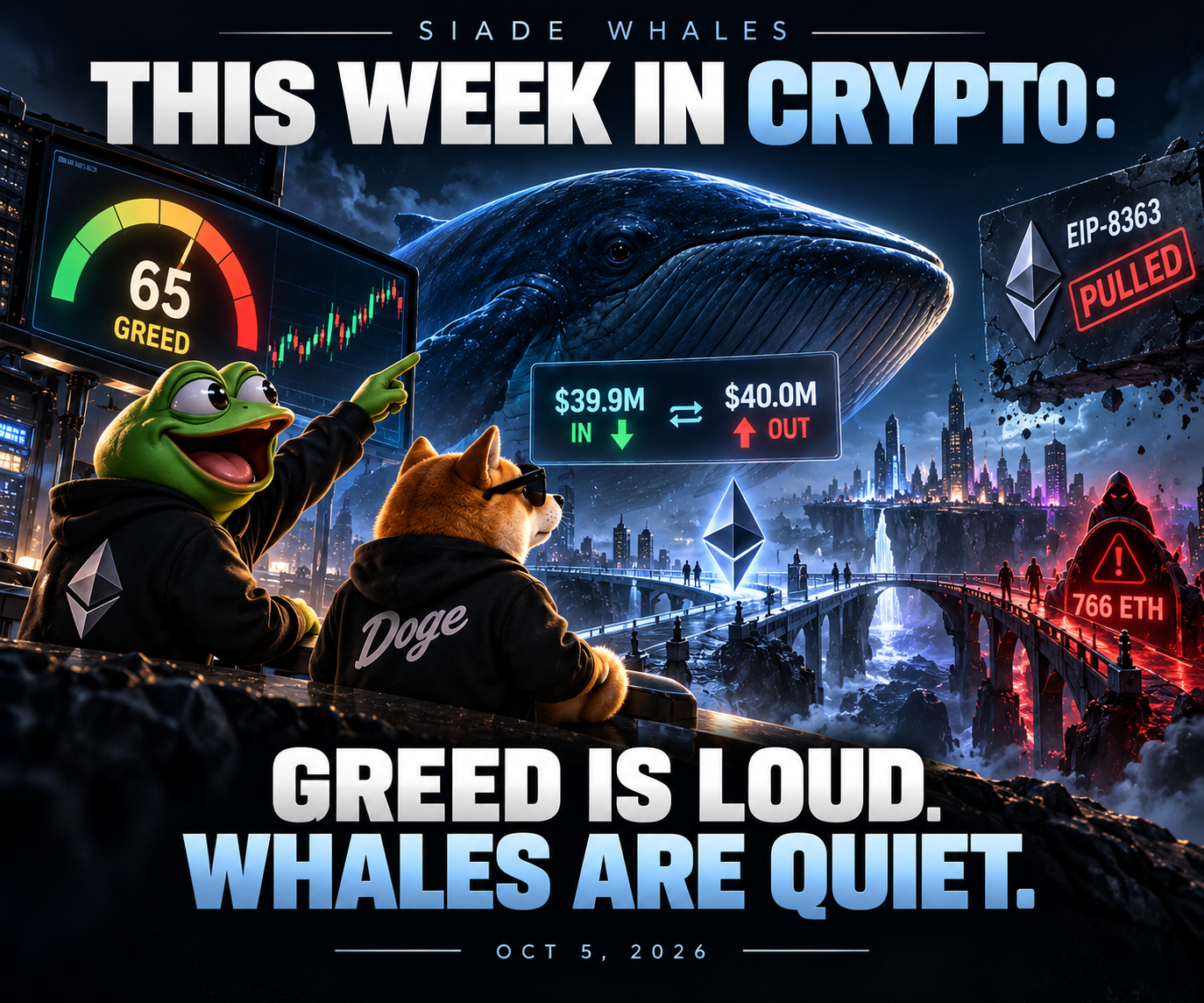
Ethereum pulled a planned cut to validator rewards out of its next upgrade, not because the number was wrong but because the room making the decision was. A fake Layer 2 bridge impersonating an Upbit-backed project took 766 ETH off people who thought they were bridging somewhere real. Underneath both, the market feels greedy — Fear & Greed sat at 65 to start the week after touching 74 — while the two numbers that actually measure holder behavior, whale flow and liquidation skew, show almost nothing.
That gap is worth sitting with.
The week in 60 seconds
- EIP-8363, a proposal to burn a growing share of Ethereum staking rewards, was pulled from the Hegotá upgrade on October 1 after Lido and other core contributors objected to the venue, not just the mechanism.
- A fake GIWA Layer 2 bridge, mistaken for the real Upbit-backed project, was drained of 766 ETH; DYORSWAP is offering 40% reimbursement to wallets that bridged under 5 ETH.
- BTC is up 1.0% on the week, ETH up 0.4%, both still comfortably green over 30 days.
- Whale transfers above $25M were balanced almost to the dollar: $39.9M into exchanges against $40.0M out.
Ethereum pulls its own reward burn from the next upgrade
Jérôme de Tychey, co-author of EIP-8363, announced on the Ethereum Magicians forum on October 1 that the proposal would not go into Hegotá. Lido's representative had asked for it to be pulled back on August 6, two days after it surfaced. The proposal drew over 200 comments in that window — a lot of attention for something that never made it to a fork.
What it would have done: burn a growing share of staking rewards as more ETH gets staked, reaching a 100% burn once staking hits roughly 60.25 million ETH. Today's issuance model keeps a yield floor around 1.5% no matter how much ETH is staked. Under EIP-8363, net yield for stakers would have dropped from about 2.6% to 1.2% — less than half.
Why it matters: validator economics aren't a side detail of Ethereum's security model, they're the whole mechanism. A yield cut that size, applied inside a routine fork scoping process rather than a dedicated issuance debate, is what actually triggered the objection — de Tychey said industry participants and core contributors convinced him the scoping process was the wrong venue for a change to issuance itself. The authors now plan a separate process for issuance policy, with Lido named among those offering to help build it. Ethereum is drawing a line between upgrading the protocol and touching its monetary policy, and saying those need different rooms. Full analysis on Siade Whales: https://siadewhales.com/article/8f91c5b9f694a456/eip-8363-authors-pull-ethereum-staking-reward-burn-from-hegota-upgrade
What to watch: whether the separate issuance process gets an actual venue and timeline, and whether total staked ETH keeps climbing toward the 60.25 million figure that made this version of the proposal so aggressive in the first place.
A fake GIWA bridge drained 766 ETH by impersonating a real exchange-backed project
A Layer 2 bridge impersonating GIWA, the Upbit-backed network, took 766 ETH from users who believed they were bridging to a legitimate chain. DYORSWAP, which mistook the fake network for the real one, is offering 40% reimbursement, capped at wallets that bridged less than 5 ETH.
Why it matters: this wasn't a contract exploit or a bridge bug. It was impersonation of a project that already has a recognizable backer, which is cheaper and more scalable than finding a code flaw. The 40% cap, limited to small bridgers, means most of the 766 ETH isn't coming back regardless of what GIWA or Upbit say next. For anyone who bridges regularly, the lesson isn't "bridges are risky" in the abstract — it's that the project name and the backer name being real doesn't mean the specific contract address is.
What to watch: whether GIWA or Upbit issue anything official distinguishing the real bridge from the fake one, and whether the same impersonation pattern — borrow a legitimate backer's credibility, fake the contract — shows up against another exchange-backed L2.
The week in numbers
- BTC $85,320, up 1.0% on the week, up 7.1% on the month — the steadier of the two majors.
- ETH $2,699, up 0.4% on the week, up 9.9% on the month — outpacing BTC over 30 days despite a flatter week.
- Total market cap $3,089.48B; BTC dominance 55.5%, ETH 10.7% — BTC still sets the tone.
- Top 20 winners: BNB +1.4%, BTC +1.0%, WBT +0.7%. Losers: DOGE -2.7%, HYPE -2.7%, ZEC -17.6% — a drop that size on one name says more about ZEC than about the market.
- Fear & Greed opened the week at 74, closed at 65 — still Greed, but fading, not reversing.
- Whales moving $25M+: 27 transfers, $3.00B total, $39.9M into exchanges against $40.0M out — close enough to call it no net direction at all.
- BTC liquidations over 7 days: $116.5M in shorts against $87.4M in longs — shorts paid more to be wrong this week.
What to watch this week
- Whether Ethereum's new issuance process gets named contributors and a timeline, or stalls the way most "separate process" promises do.
- Whether another fake bridge copies the GIWA playbook against a different exchange-backed L2.
- ZEC's -17.6% weekly move against a market where BTC dominance barely moved — worth checking whether that's isolated or the start of something.
- Whether whale flow breaks its near-perfect balance ($39.9M in versus $40.0M out) in either direction, which would be the first real signal of the week rather than sentiment.
Greed at 65 after touching 74 reads like a market that wants to believe something, not one that's actually moving size. The holders who matter — the ones above $25M — didn't pick a direction this week, and neither did the liquidation data in any way that survives scrutiny.